
GEO vs SEO vs AEO vs LLMO: What They Mean
Four acronyms, one axis. What GEO, SEO, AEO, and LLMO each optimize for, which are real, and which a founder should do first.
 By David Jubé · May 25, 2026 · 14 min read
The comparison terms alone draw roughly 7,600 searches a month combined, with “geo vs seo” leading at about 2,900, which tells you the confusion is real and widespread.
The short version: SEO gets you ranked, AEO and GEO get you cited in AI answers, LLMO is about influencing the model itself, and all four ride on the same underlying way engines choose sources.
If you only remember one thing, remember that.
The acronyms multiplied faster than the actual disciplines did. Three of the four describe overlapping work, one of them is mostly a rebrand, and the founder question hiding under all the noise (“which of these should I spend time on?”) has a clean answer that we will get to.
First, the definitions, because you cannot decide what to ignore until you know what each word is pointing at.
Key takeaways
- SEO gets you ranked, AEO and GEO get you cited in AI answers, LLMO is about influencing the model itself, and all four ride on the same underlying way engines choose sources.
- SEO is the outlier because it targets a list of links, while AEO, GEO, and LLMO all target a synthesized answer from slightly different angles.
- GEO and AEO overlap so heavily that they describe two views of the same work, and selling them as separate line items is a pricing decision, not a technical one.
- LLMO splits into the part you cannot directly control and the part that is just GEO under a new name, leaving entity clarity and brand consistency as the only genuinely distinct slice.
- Do SEO first because it builds the retrieval and evaluation signals every other discipline reuses, then make those pages citable and you have covered AEO, GEO, and the useful slice of LLMO in one motion.
The four acronyms in one sentence each
Here is each term, stripped to its job:
- SEO (Search Engine Optimization) is the practice of getting your pages to rank as clickable links in traditional search results like Google and Bing.
- AEO (Answer Engine Optimization) is the practice of structuring content so it wins direct answers: featured snippets, answer boxes, and the concise responses AI assistants speak or display.
- GEO (Generative Engine Optimization) is the practice of earning citations inside the longer answers that generative engines compose, such as Google AI Overviews and Perplexity.
- LLMO (Large Language Model Optimization) is the practice of shaping how large language models like ChatGPT, Claude, and Gemini understand and recommend your brand in conversational replies.
Read those four again and you will notice the overlap. SEO is the outlier (it targets a list of links).
The other three all target a synthesized answer, just from slightly different angles: AEO wants the short answer, GEO wants the citation in the long answer, LLMO wants the model to vouch for you in conversation.
That overlap is the whole story, and it is why the labels create more confusion than clarity.
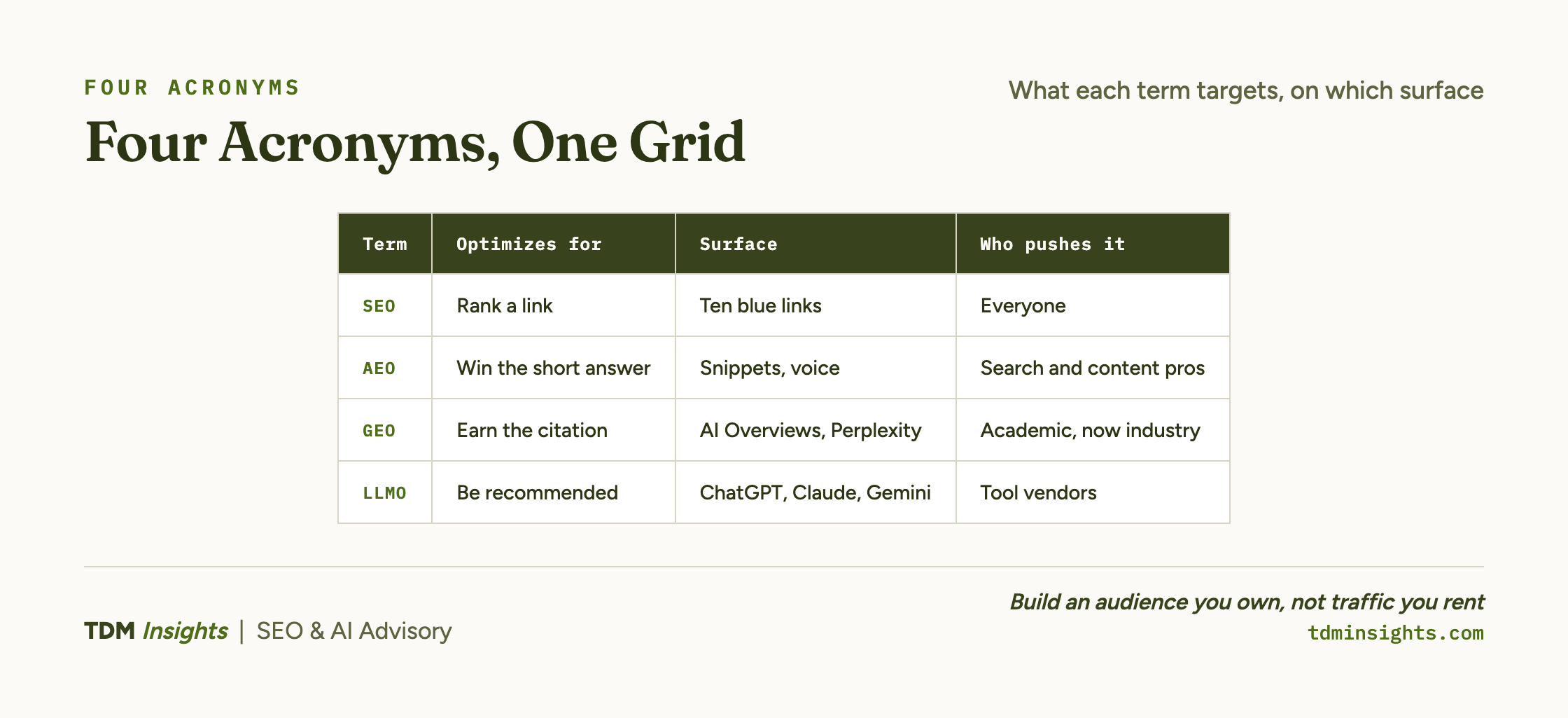
The most useful way to cut through it is to put all four on a single grid.
The comparison table: surface, goal, primary lever, who cares
Here is how the four terms line up on the dimensions that actually differ.
A few things jump out of the grid.
The “primary lever” column repeats itself: answer-first structure, authority, corroboration, and clarity show up under almost every term.
The “surface” column is where the real difference lives, because targeting a link is genuinely different work from targeting a synthesized answer.
And the “who pushes the term” column is the honest one: SEO is a discipline, GEO came out of a research paper, and LLMO is mostly a vendor coinage.
Hold that distinction. It decides where your attention goes later.
For a fuller side-by-side that walks each term through its own definition, this side-by-side of GEO, AEO, AI SEO, and LLMO covers the same disambiguation in more depth.
SEO vs AEO: ranking versus being cited
SEO and AEO are not competitors. They are two finish lines on the same track.
SEO’s finish line is a ranked link. You earn position three, a searcher scans the results, clicks your link, and lands on your page.
The win is the click.
Everything in classic SEO (crawlability, backlinks, page speed, keyword relevance) exists to move you up that list so the click is more likely.
AEO’s finish line is a citation. A searcher (or an AI assistant on their behalf) asks a question, the engine composes a single answer, and your page is the source it quotes.
The win is being named, even when the user never clicks through to your site.
That last part is the uncomfortable change: AEO can deliver visibility and authority without delivering a session in your analytics.
The mechanical difference is structural. SEO rewards a page that is comprehensive and well-linked. AEO rewards a page that contains a passage answering one specific question completely, in a form an engine can lift without editing.
A page can do the first and fail the second.
That gap (“we rank but never get cited”) is the most common complaint founders raise, and it is an AEO problem sitting on top of perfectly healthy SEO.
To understand why a page clears ranking but fails citation, you have to look at the one mechanism underneath all four acronyms, which we get to below.
GEO vs AEO: a real difference, or just two names?
This is the question that drives most of the search volume, so here is the honest answer.
GEO and AEO overlap heavily and most of the time you can treat them as one effort, but they are not identical.
AEO grew out of the featured-snippet and voice-search era. Its instinct is to win the short, direct answer to a question.
GEO is the newer term, and it grew out of academic work, specifically the original GEO research paper, a Princeton-led study presented at KDD 2024 that coined “Generative Engine Optimization” and tested which content changes increased a source’s visibility inside generated answers.
GEO’s instinct is to earn a citation inside a longer, composed response, not just to own a one-line box.
So the split is intent, not toolkit. AEO answers a question. GEO earns a reference.
Because no single primary source defines GEO for practitioners, the trade has settled on a shared shorthand, and the trade’s working definition of GEO lands in the same place: optimizing your content to be referenced inside generative answers.
In practice you optimize a passage to be both: a clean, self-contained answer (AEO) that an engine is willing to quote and attribute inside a paragraph it is writing (GEO).
Backlinko’s GEO explainer walks through the tactics that move the GEO needle, and you will notice they read almost identically to good AEO advice.
The two names describe two views of the same work.
If a vendor tries to sell you GEO and AEO as separate line items, that is a pricing decision, not a technical one.
LLMO and the “optimize for the model” idea, and its limits
LLMO is the most ambitious of the four claims and the one to be most skeptical about.
The premise of LLMO is that you can influence how a model itself (not a search index, the model) understands and recommends your brand.
When someone asks ChatGPT “what’s the best project management tool for a small agency,” LLMO is the work of trying to be the brand it names.
That is a real and valuable outcome. The question is how much of it you can actually steer.
Two limits matter.
First, a model’s default answer comes from its training data, which was frozen at a cutoff date and which you cannot edit. You influence it the slow way, by building enough authoritative, consistent, widely corroborated presence that future training runs and retrieval calls pick you up.
There is no markup, no file, and no quick switch.
Second, the moment a model runs a live web search, you are back in GEO and AEO territory, because now it is retrieving and citing pages in real time.
So LLMO splits into “the part you cannot directly control” (training) and “the part that is just GEO under a new name” (retrieval).
What is left as genuinely distinct is narrow: entity clarity and brand consistency so the model maps your name to the right concepts. Useful, worth doing, but not a separate budget.
LLMO overlaps with GEO so completely that the difference is mostly scope and origin, GEO being the broader, research-born term and LLMO the practitioner label aimed specifically at the models.
The one mechanism underneath all four
Here is the payoff for sitting through four definitions.
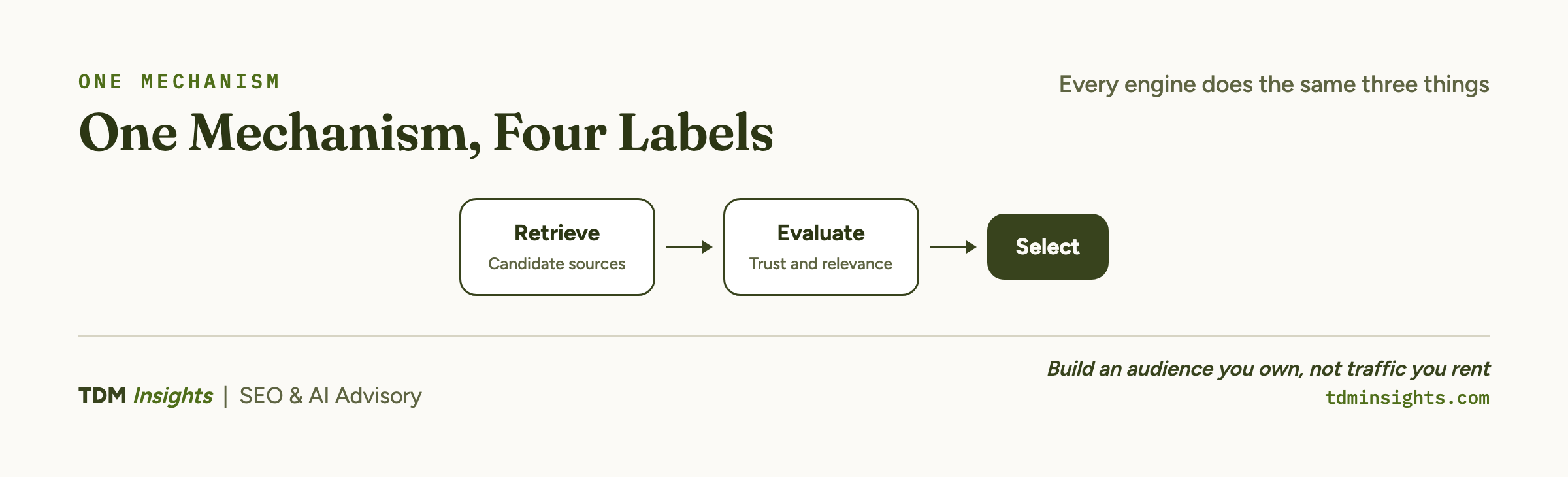
Underneath SEO, AEO, GEO, and LLMO is a single process, and once you see it the acronyms stop mattering.
Every engine that surfaces your content does three things in order.
It retrieves a set of candidate sources for the query. It evaluates those candidates for trust and relevance. It selects what to show, whether that is a ranked link (SEO), a quoted snippet (AEO), or an attributed citation inside a composed answer (GEO and the retrieval side of LLMO).
The labels just describe which output of that final step you are aiming at. The retrieval and evaluation steps are nearly identical across all four.
That is why traditional ranking still matters for AI visibility, even though it matters less absolutely than it used to.
AI engines run their own retrieval, but a page with the authority and relevance signals that earn a good Google ranking tends to carry the same signals an engine’s evaluation step rewards.
The overlap is real, which is what makes the SEO foundation all of this rests on non-negotiable.
It has also been loosening: Ahrefs data on AI-cite versus ranking overlap shows AI retrieval increasingly diverges from the classic top ten, and AI Overview citations and top-10 rankings documents the same drift.
The takeaway is not “ranking is dead.” It is “ranking is a strong input to a separate selection step, not the selection step itself.”
If you want the full version of how that three-stage process works, that is exactly the one mechanism underneath all four acronyms.
Book a free diagnosis
Four acronyms, limited hours, and a vendor or two trying to sell each one as its own line item. If you are not sure where SEO, AEO, GEO, and LLMO actually sit on your roadmap, you do not need another framework. You need someone to look at your site and say what to do first. We will map your pages to the one mechanism underneath all four and hand you a free diagnosis you can act on this quarter.
What a founder should actually do first
You have four acronyms and limited hours. Here is the order, and the reasoning.
Do SEO first. Not because it is trendy (it is the opposite of trendy) but because it builds the retrieval and evaluation signals every other discipline reuses. If you are still weighing the call, whether SEO is worth it for a startup is the prior question to settle, and an honest timeline for how long SEO takes sets the expectation before you commit.
If your pages are not crawlable, indexed, and trusted, there is nothing for an answer engine to retrieve, so AEO and GEO have no raw material to work with.
Build the base, starting from the keyword research that finds demand you can actually win so the pages you build are aimed at queries within reach.
The way you build authority efficiently is with structured topic coverage, which is how topic clusters build the authority engines reward.
Layer AEO and GEO together, as one effort. Once pages rank and earn trust, the marginal work to make them citable is small and mostly editorial: lead each section with a direct, self-contained answer, keep claims liftable, add the structured data engines can parse.
Treat AEO and GEO as a single “make it citable” pass rather than two projects.
The high-authority view from HubSpot’s generative engine optimization overview lands in the same place: GEO layers onto strong SEO, it does not replace it.
Treat LLMO as a byproduct, not a project. Get your entities clear and your brand described consistently across your authoritative pages, and you have done the controllable part of LLMO. The rest follows from the work above.
So the answer to the question everyone is searching is anticlimactic and correct: do the SEO, then make it citable, and you have covered AEO, GEO, and the useful slice of LLMO in one motion.
When you are ready to move from definitions to execution, here is how to actually get cited in AI answers, and if you want the category from the ground up, start with what answer engine optimization actually is.
The acronyms all rest on one mechanism. See exactly how engines find, evaluate, and cite a source. Read S2.
Frequently Asked Questions
Is GEO the same as AEO?
No. AEO (Answer Engine Optimization) targets direct, question-based queries so your content wins concise answer boxes and snippets. GEO (Generative Engine Optimization) targets citations inside longer AI-generated answers from tools like AI Overviews and Perplexity. They overlap heavily but differ in intent: AEO answers a question, GEO earns a reference.
Do GEO and AEO replace SEO?
No. Generative and answer engines rank candidates using the same authority and relevance signals that power traditional search, so SEO remains the foundation. Studies show a large share of AI Overview citations come from pages already ranking in the top organic results. GEO and AEO layer onto strong SEO; they do not substitute for it.
Which should I focus on first, SEO or GEO?
Focus on SEO first. It establishes the crawlability, authority, and relevance signals that AI systems reuse when selecting sources to cite. Once your pages rank and earn trust, layer AEO to win direct answers and GEO to earn citations in generative results. Skipping the SEO base leaves the newer tactics with nothing to build on.
Are AEO and GEO real disciplines or just rebranded SEO?
Mostly rebranded SEO, with a genuinely new edge. Google has stated that optimizing for generative AI search is still optimizing for search. The craft is largely shared with classic SEO. The remaining slice (citation optimization, multi-platform visibility, consensus signals) is new enough to warrant attention, but not a separate budget or vendor.
What does LLMO mean and how is it different from GEO?
LLMO (Large Language Model Optimization) shapes how models like ChatGPT, Claude, and Gemini understand and recommend your brand in conversational replies. It overlaps heavily with GEO. The split is scope and origin: GEO came from academic research and covers all generative engines, while LLMO is a practitioner term aimed specifically at large language models.
Does ranking in Google still matter for AI search visibility?
Yes, though less absolutely than before. Research consistently finds a meaningful share of AI Overview citations come from pages ranking in the top organic results, even as that overlap has loosened over time. Ranking well signals authority that AI systems reward, so traditional rankings remain a strong lever for getting cited.
Continue Reading:
More On Answer Engine Optimization
- Answer Engine Optimization: What AEO Actually Is
- How AI Answer Engines Choose Their Sources
- How to Get Cited by ChatGPT, Perplexity, and AI
- Schema Markup for AI: Answer-First Writing Guide
- How to Measure AI Traffic With No Referrer
- Entity SEO: How to Become a Known Thing to AI
- The On-Page AEO Playbook: Build Pages AI Quotes
More from TDM Insights
- SEO for Startups: What to Do in the First 90 Days
- Is SEO Worth It for a Startup? When to Invest and When to Wait
- How Long Does SEO Take? An Honest Timeline
- Keyword Research for Startups: Demand You Can Win
- Topic Clusters and Pillar Pages: How They Work
Explore TDM Insights Categories