
From Zero: A Cold-Start Cluster
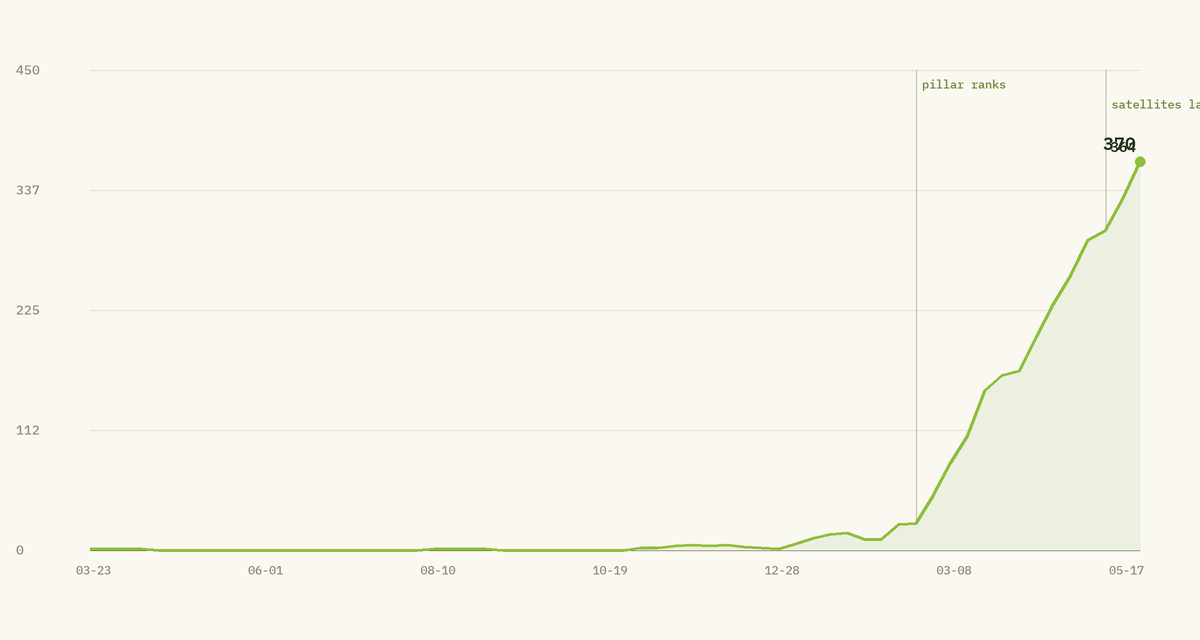
Starting from no presence at all, a party-drinks cluster went from near zero to 370 organic clicks per 28 days in about three months.
 By David Jubé · May 26, 2026 · 7 min read
A cluster story usually starts from an existing signal: an old page that already trickles traffic, a topic the site half-ranks for. This one did not. In party drinks, the site started from nothing. No ranked pages, a handful of clicks a month, often zero.
That makes it the harder, more honest test. Not can you grow a topic you already touch, but can you enter a topic cold and rank? Here is what the cold start looked like.
Here is the cold start, measured as a trailing 28-day click total each week.
Key takeaways
- Starting from near zero, a party-drinks cluster reached 370 organic clicks per 28-day window in about three months.
- A single welcome-drinks pillar page led the way, then satellite pages on non-alcoholic, Spanish, and French drinks followed it onto page one.
- By May 24 the cluster drew 469 organic sessions across 22 pages in GA4: people did not just find it, they read it.
The starting point: effectively zero
For more than a year the site had no drinks presence to speak of. The combined party-drinks pages pulled between zero and a few organic clicks per 28-day window, the signal of a topic the site simply did not rank for.
There was no quiet page to build on, no trickle to read as demand. The decision to enter was a bet on the topic, not a response to an existing signal.
The method: lead with a pillar, follow with satellites
The cluster led with one broad pillar page on welcome drinks, the entry point to the whole topic. Then satellite pages went deep on specific, winnable angles: non-alcoholic options, Spanish drinks, French drinks, kid-friendly drinks, drink-and-snack pairings.
Each satellite targeted a distinct, searchable question and linked back to the pillar and across to its siblings. The aim was the same as any cluster: cover the topic deep enough that the group reads as one credible resource.
| Page | First seen | Reached page 1 | Clicks (28d) | Position |
|---|---|---|---|---|
| welcome-drinks (pillar) | Feb 22 | Feb 22 | 171 | 7.0 |
| french-non-alcoholic-drinks | Apr 5 | Apr 5 | 79 | 5.8 |
| non-alcoholic-spanish-drinks | Apr 5 | Apr 5 | 62 | 7.8 |
| spanish-drinks-non-alcoholic | May 10 | May 10 | 6 | 6.5 |
| 10-welcome-drink-ideas | May 10 | May 10 | 4 | 7.3 |
| drinks-for-kids | Feb 22 | climbing | 10 | 11.8 |
What the numbers did
The cold start behaved like a cluster, just from a lower base. Flat, then a climb as the pillar ranked, then a steeper climb as the satellites landed and pointed at each other.
| 28 days ending | Organic clicks (28-day) | Note |
|---|---|---|
| Through 2025 | 0 to 4 | no presence in the topic |
| Feb 22, 2026 | 25 | pillar page ranking |
| Mar 22, 2026 | 150 | satellites entering the data |
| Apr 19, 2026 | 231 | |
| May 17, 2026 | 329 | |
| May 24, 2026 | 370 | 22 pages, 469 GA4 sessions |
And people read what they found. In the 28 days ending May 24, the cluster drew 469 organic sessions and 603 page views across 22 pages in GA4. A cold topic, entered deliberately, turned into an audience.
What made the cold start work
Two things. First, the pillar ranked before the satellites arrived, so when the satellites linked back they were linking to a page Google already trusted a little. The order mattered.
Second, the satellites were chosen for winnability: specific, lower-competition angles where a new page could realistically reach page one, rather than broad terms it would never crack from a standing start.
What this teaches
- You can enter a topic cold. No existing signal is required. A topic with real demand can be entered from zero, if you build depth rather than a single hopeful post.
- Rank the pillar first. The broad pillar page is the anchor the satellites link back to. Get it ranking before the satellites land so they inherit a trusted target.
- Pick winnable angles, not vanity terms. From a standing start, target specific, lower-competition questions a new page can actually reach page one for. Breadth comes later, once authority exists.
- A cold start is slower at the base, same shape on top. Without an existing trickle the first weeks feel emptier. The curve still bends once the pillar ranks and the satellites link. Expect the lag and fund it.
- Write for readers, then check they read. GA4 sessions, not just clicks, tell you the content held people. 469 sessions across the cluster is the difference between ranking and being useful.
What this does not claim
Honesty keeps the note useful. Party drinks ride a seasonal rise into spring and summer, so demand grew under this cluster as well as because of it. The site’s overall authority was climbing across the window too, which helps a new cluster rank faster than it would on a brand-new domain. And a 28-day click total is a visibility and engagement measure, not a revenue figure. What the data supports is the shape and the order: a topic the site did not rank for reached a ranking cluster of 22 pages in about three months, led by a pillar that ranked first and satellites that followed it.
Frequently Asked Questions
How long does it take a new page to rank on Google?
Plan for weeks to a few months, not days. A new page has to be crawled, indexed, and earn enough trust to rank. In the cluster above, pages on winnable, lower-competition terms reached page one within a few weeks, while the topic as a whole took about three months to build real traffic.
Can a new website or new topic rank without backlinks?
Yes, especially on lower-competition terms and when the new pages sit inside a well-linked cluster on an established site. Internal links and topical depth do a lot of the work. Brand-new domains with no authority will be slower, which is why winnable angles matter most at the start.
What are low-competition keywords and why do they matter?
Low-competition keywords are specific, often longer search terms that fewer strong pages target, so a new page can realistically reach page one for them. They matter because, from a standing start, you win the winnable terms first, build authority, then compete for broader, harder terms later.
Should I publish one big page or several smaller ones for a new topic?
Several, built as a cluster. One broad pillar page anchors the topic, and satellite pages each go deep on a specific question and link back. The pillar earns broad terms, the satellites earn long-tail terms, and the internal links pass authority around the group.
How do I enter a topic my site has never ranked for?
Lead with a pillar page on the broad topic, get it ranking, then add satellite pages on specific, winnable subtopics that link back to it. Choose angles where a new page can realistically reach page one rather than the most competitive head term, and build depth before chasing volume.
How do I know if a new topic is worth entering?
Look for real, durable search demand and angles you can realistically win, rather than an existing trickle on your own site. The drinks cluster above started from near zero on the site but targeted questions people genuinely search, which is why a cold entry could still turn into a ranking cluster.
The takeaway in one line: you do not need an existing foothold to win a topic, you need a pillar that ranks and satellites built on winnable angles around it.
Wondering which untouched topics your site could actually enter and win? A free diagnosis maps the winnable gaps first.
Continue Reading:
More From This Series
- Build the Cluster, Not the Post
- Clusters Compound. Scattered Posts Plateau.
- The CTR Fix: Same Ranking, More Clicks
- The Experiment We Killed
More from TDM Insights
- Keyword Research for Startups: Demand You Can Win
- SEO for Startups: What to Do in the First 90 Days
- How Long Does SEO Take? An Honest Timeline
- Free Keyword Research: A Starter Method, No Tools
- Topic Clusters and Pillar Pages: How They Work
Explore TDM Insights Topics