
Clusters Compound. Scattered Posts Plateau.
Three content clusters we built each grew 12x to 108x in organic clicks, while scattered standalone pages grew about 7x. Why depth compounds.
 By David Jubé · Jun 9, 2026 · 6 min read
One cluster climbing could be luck: a good topic, a seasonal tailwind, a lucky link. Three clusters that all climb the same way, on the same site, in the same window, are a pattern. That is what this note is about.
We build content in clusters: a group of interlinked pages that cover one topic in depth, rather than single posts scattered across the site. Three of those clusters are now old enough to read clearly. So are the pages we never clustered. The contrast is the lesson.
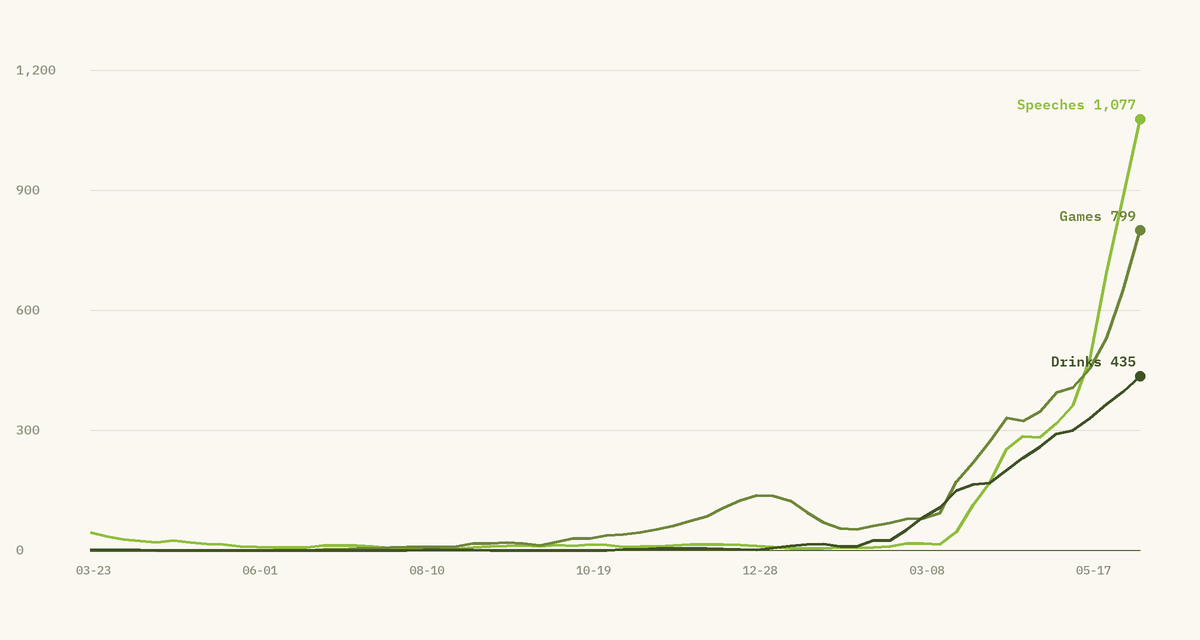
Here are the three cluster curves on one axis, each a trailing 28-day click total sampled weekly.
Key takeaways
- Three separate clusters (speeches and toasts, party games, party drinks) each grew between 12x and 108x in organic clicks once built and interlinked.
- Over the same window, the site’s scattered, un-clustered pages grew about 7x combined.
- The compounding is structural, not topic-luck: depth plus internal links is what bends each curve.
The three clusters, same shape
Each cluster started as a thin presence or nothing at all, then bent upward once we built it out with depth and links. The starting points differ. The shape does not.
| Cluster | 28-day clicks, Feb 22 | 28-day clicks, Jun 7 | Growth |
|---|---|---|---|
| Speeches and toasts | 10 | 1,077 | 108x |
| Party games | 68 | 799 | 12x |
| Party drinks | 25 | 435 | 17x |
| Three clusters combined | 103 | 2,311 | 22x |
Different topics, different audiences, different seasons. The same curve each time. When the inputs are the same (depth, internal links, patience) the output rhymes.
The pages we left scattered
Not everything on the site is in a cluster. A large share of the library is standalone posts: one page on a topic, no satellite pages around it, few internal links tying it to anything else. Those pages are the control group.
Across the exact same window, the site’s un-clustered pages grew about 7x in combined organic clicks. Real growth, helped by the whole site gaining authority. But roughly a third of the rate the weakest cluster managed, and a fraction of the strongest.
| Group | Growth since Feb 22 | The read |
|---|---|---|
| Strongest cluster (speeches) | 108x | built deep, built early |
| Weakest cluster (games) | 12x | still well ahead of scattered |
| Scattered, un-clustered pages | 7x | rises with the tide, does not compound |
A rising tide lifts the scattered pages. It does not compound them. Compounding needs structure.
Why depth compounds and scattering does not
A single post can only rank for the handful of terms it directly targets. It sits alone, so the authority it earns stays with it.
A cluster behaves differently. Each page targets its own slice of the topic, so the group earns a wide family of terms. And because the pages link to each other, the authority each one earns flows to the others. New pages added later inherit that pooled trust and rank faster than a standalone page ever could.
That is the compounding engine: breadth of terms times shared authority. Scatter the same number of posts across unrelated topics and neither effect fires.
What this teaches
- Depth beats breadth-of-topics. Ten pages deep on one topic compound. Ten pages on ten topics do not. Concentrate effort where you can build a real cluster.
- The pattern repeats, so you can plan it. Three clusters, three of the same curve. A compounding cluster is a repeatable play, not a one-off win. Pick the next topic and run it again.
- Internal links are the mechanism, not decoration. The lift travels between pages through the links. A cluster without dense internal linking is just scattered posts in a folder.
- Scattered posts are un-built clusters. A standalone page that holds steady traffic is a cluster waiting to be built. Treat your best orphans as cluster seeds.
- Measure the curve, not the week. Each cluster looked unremarkable for weeks before it bent. Judge a cluster on its trajectory over a quarter, not its first fortnight.
What this does not claim
Honesty keeps the note useful. The whole site’s authority grew across this window, which lifts every page, clustered or not, so part of all these curves is the rising tide. Seasonality helps some clusters: speeches and drinks both ride spring and summer demand. Cluster size differs too, since the strongest cluster is also the largest and the earliest, so age and depth are tangled together here. What the data does support is the shape: three deliberately-built clusters each bent sharply upward, and the un-clustered pages, on the same site in the same window, did not.
Frequently Asked Questions
What is a content cluster in SEO?
A content cluster is a group of interlinked pages that cover one topic in depth: a pillar page giving the overview plus satellite pages on specific subtopics, all linking to one another. Search engines read the group as a single authoritative resource, so the pages rank better together than any would alone.
Do content clusters actually work?
Yes, and the effect compounds. On the site above, three separate clusters each grew between 12 and 108 times in organic clicks once built and interlinked, while scattered standalone pages on the same site grew about 7 times in the same window. Depth plus internal links drove the difference.
How is a topic cluster different from scattered blog posts?
Scattered posts each target one topic in isolation and keep the authority they earn to themselves. A topic cluster covers many angles of one subject and links the pages together, so they share authority and rank for a wide family of terms. Structure is the difference, not effort.
What is a pillar page?
A pillar page is the central page of a cluster. It gives a broad overview of the topic and links out to every satellite page covering a subtopic in detail. The satellites link back. The pillar earns broad terms, the satellites earn long-tail terms, and links pass authority both ways.
How long does a content cluster take to compound?
Expect a slow start before the sharp climb. Each cluster above looked flat for weeks while pages were crawled, indexed, and trusted, then bent upward over a quarter. Judge a cluster on its trajectory across several months, not its first two weeks, and build ahead of the demand you want.
How many clusters should a site build?
Build clusters one topic at a time, deep enough that each compounds, rather than spreading effort thin across many shallow topics. The pattern repeats reliably, so a practical approach is to prove one cluster, then run the same play on the next topic you can realistically win.
The takeaway in one line: build topics deep enough to compound, because scattered posts only ever ride the tide while clusters make their own.
Want to know which of your standalone pages are really un-built clusters? That is one of the first things a free diagnosis maps.
Continue Reading:
More From This Series
- Build the Cluster, Not the Post
- The CTR Fix: Same Ranking, More Clicks
- From Zero: A Cold-Start Cluster
- The Experiment We Killed
More from TDM Insights
- Topic Clusters and Pillar Pages: How They Work
- Content Strategy for Founders: A Library That Ranks, Gets Cited, and Pays for Itself
- Keyword Research for Startups: Demand You Can Win
- How to Build a Content Funnel (TOFU to BOFU)
- How Long Does SEO Take? An Honest Timeline
Explore TDM Insights Topics