
Service Page Content Examples: Six Sections in Order
Service page content examples that name the deliverable: the section order, what each part must say, and the vague version to avoid.
 By David Jubé · Aug 13, 2026 · 14 min read

Your service page can rank for its category and still leave a buyer unable to say what arrives. You hear the evidence on the phone. “So what do I actually get?” is the question somebody asks about the page that was supposed to answer it.
That page named a category, listed four benefits, and closed with a form. It never said what arrives, what it covers, or what it leaves out. Pages fail this way when they are written for a ranking rather than for the person reading them, and the symptom is always the same: nowhere on the page does anybody say what the buyer receives.
Key takeaways
- Name the deliverable in the buyer’s units in the header. The first question on any page is whether the visitor is in the right place.
- Section order follows a buyer’s questions in sequence, so a page answering them out of order loses the reader early.
- Vague copy is usually deliberate. Language watered down to address several markets gives nobody enough to decide on.
- Proof works without a client name. A vertical, a starting condition, a counted change and a window stay confidential and still convince.
- The set outgrows one writer before any single page does. Past eight service pages, the job becomes holding a set consistent.
Name what the buyer receives before you name the category
Every visit starts with one silent question, and it is not “is this any good”. It is “am I in the right place”. A header naming a category answers a different question, and a header naming nothing at all hands the work back to the visitor, who does it by scrolling and often by leaving.
Orbit Media’s checklist for a service page opens there, and the real page headers it collects are the useful part. “We take excellence to new levels” and “Transforming experiences one brand at a time” both sit atop pages selling something, and neither tells the visitor what.
So name the deliverable, in the units the buyer counts in.
- If they buy a thing, name it and its size. “A five page WordPress site” beats “digital presence”.
- If they buy an outcome, name the artefact that proves it arrived. “A written technical audit, fixes ranked by severity” beats “SEO services”.
- If the work recurs, name the cycle and its deadline. “Monthly bookkeeping, closed by the tenth” beats “support”.
Jargon does the same damage from the other direction. Unbounce’s walkthrough of pages whose copy hides the offer reads pages where the visitor is left asking what a material even is, and its rule is blunt: anything making the offer harder to understand goes.
Naming the offer is machine-readable work as well as human work. The schema.org spec for Service carries serviceType, provider and areaServed, which are the facts a buyer scans a header for. The same naming happens one step earlier, in the search result itself, and Title Tags and Meta Descriptions That Get Clicks covers that half. Once a visitor knows they are in the right place, they start asking everything else, and they ask it in a fixed order.
Section order follows the questions a buyer asks, in the order they ask them
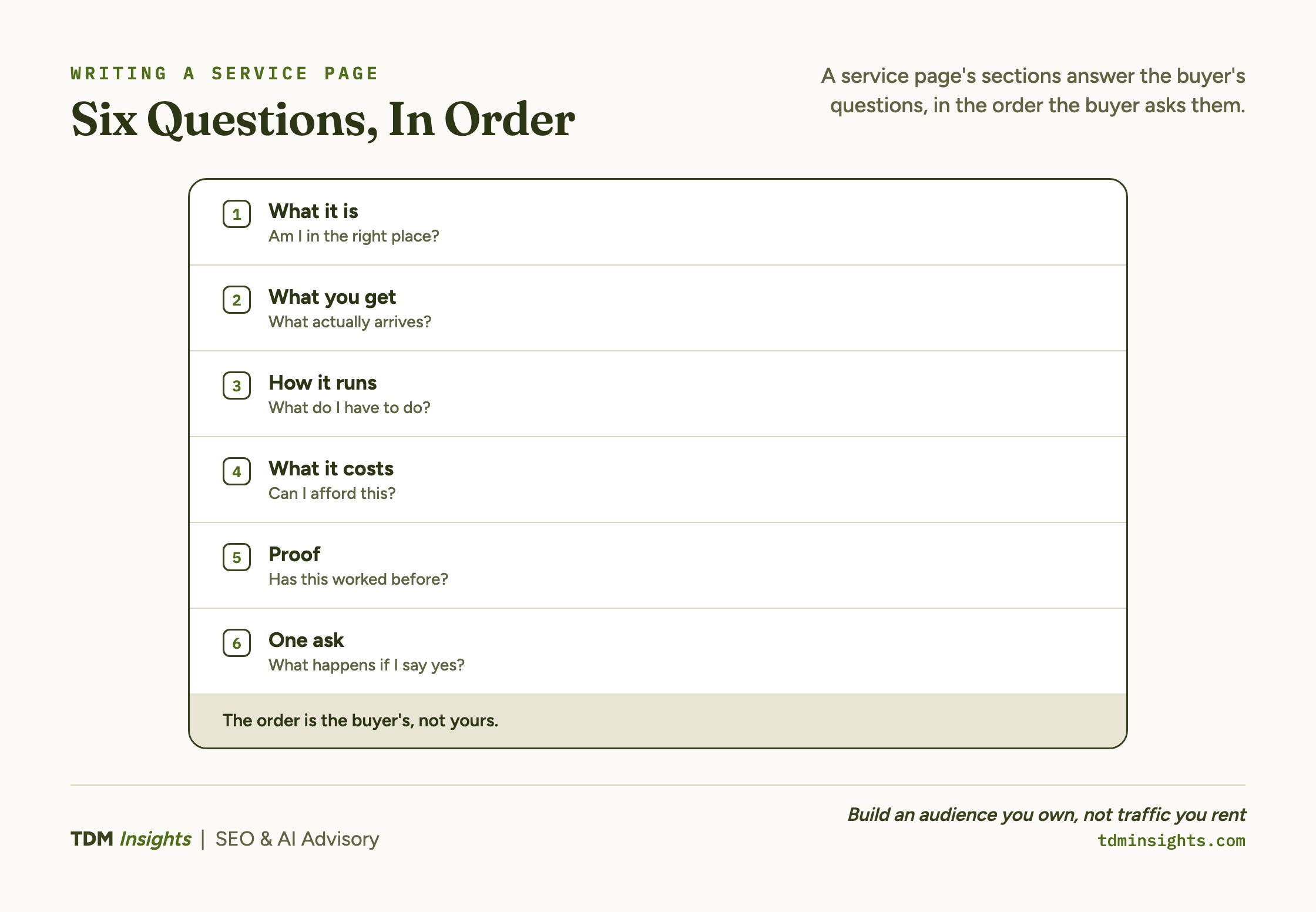
Six sections, in this sequence, because each is a question and the questions arrive in a fixed order.
- What it is, named as a deliverable. Am I in the right place?
- What you get, itemised. What actually arrives?
- How it runs, with the buyer’s part named. What do I have to do?
- What it costs, or why there is no number. Can I afford this?
- Proof, from someone in the same situation. Has this worked before?
- One ask. What happens if I say yes?
A buyer who cannot answer question two never reaches question five. Put proof above the deliverable and you are asking somebody to be impressed before they know what you sell, which is how a beautifully designed page can win the ranking and close nothing. Semrush’s guide to landing page optimization walks a commercial page section by section and lands on a similar sequence.
Of the six, the fourth is the one owners argue about, and it is the one a buyer uses to decide whether the other five were worth reading. Content That Converts Readers Into Customers carries the conversion argument underneath the whole sequence.
Price sections earn their keep, and withholding a number needs a stated reason
Publish a number if one exists. If none does, say why on the page, in a sentence.
BrightLocal’s survey on what people want from a business website is the oldest source here and its finding has held up: no phone number, no price list and thin content were the main turnoffs. A priced service list is what lets somebody evaluate you without calling, and calling is a cost they may decide not to pay.
When a fixed price genuinely does not exist, three formats still let a buyer place themselves. A starting figure with its base scope named beside it. A band, with the two variables that move it named rather than left as “it depends”. Or a rate per unit, such as per page or per room, which a buyer can multiply themselves.
Each works because it lets a reader find out they are out of range before they spend a call finding out. Silence does not protect the deal. It moves the disqualification into a conversation you both sat through, and the buyer remembers who wasted the half hour.
Pricing is the same fact in machine-readable form. The schema.org spec for Offer carries price and priceSpecification, and Schema Markup for AI: Answer-First Writing Guide covers writing copy that markup can describe truthfully.
Saying what you do not do is what makes the rest believable
An inclusions list alone reads as a sales page. Put an exclusions list beside it and the page reads as somebody who has run this job before and knows where it goes wrong, which is a claim about competence that costs you nothing to make and cannot be copied by anyone who has not run the job.
Four things belong here: what is included, what is not, where excluded work goes, and what changes scope. The third matters more than it looks, because a buyer who reads that you do not do photography and are happy to work alongside their photographer has been told you have done this before.
Baymard’s research on product description sufficiency found around 10% of the e-commerce sites it studied carry descriptions too thin to evaluate the item. A service page with no boundaries has the same defect. You can read every word and still not be able to say what you would be agreeing to.
The exclusion test
Read your service page and try to name one thing it will not do. If you cannot, the page describes a category rather than an offer, and the buyer has nothing to measure themselves against.
Proof can be specific and countable without naming a single client
Ranking for a query and saying something on the page are separate achievements. Moz’s analysis of home services businesses ranking on page one found 61% carried reviews on the location page while only 32% carried a unique value proposition, and roughly a quarter carried an offer at all. Those pages won the query and still did not say what set them apart.
A proof line you can publish without anyone’s permission has four parts.
- The vertical rather than the company. “A regional dental group”, not the name.
- The starting condition, as a number the reader can picture.
- What changed, counted, over a stated window.
- What you did, in one clause.
The starting condition and the window are the two parts that usually go missing, and they are the two doing the work. A claim without a starting condition cannot be sized, so the reader has no idea whether the change was large. A change with no window could have taken three years, which makes it a coincidence rather than a result.
One ask, placed where the buyer has finished deciding
One ask per page, in the same words each time. Two competing asks make a reader choose between them instead of choosing you, and a reader who stalls on that choice leaves with neither.
Place the ask after the proof section, where the decision actually happens, and say what the buyer receives for the click. “Contact us” describes an action. “Book a thirty minute call and leave with a written scope” describes what they walk away holding.
Backlinko’s case study on conversion-focused changes to a page is one site rather than a survey, so it is worth reading for the mechanics of what was changed. The One-CTA Rule: One Ask Per Page Wins argues the single-ask case, and Where to Place a CTA So It Gets Clicked covers placement, which service pages get wrong more than wording.
Vague against specific, the same six sections written both ways
Service page content examples only earn their keep in pairs. Below is one business, one set of six sections, written twice.
Vagueness is rarely carelessness. Orbit Media on the five kinds of specificity a page needs names the cause: copy watered down to address several markets at once ends up excluding everyone. Its examples are the “What we do” and “Our solutions” subheads that manage not to say what you do.
The second reason a section stays vague is that the specific version was never available to write. Nobody had written down the price bands, the exclusions, or the numbers behind the proof line, so the copy defaulted to the version needing no facts at all. A drafting tool cannot supply them either, since it holds nothing about your business until you hand it something, and AI Website Copy: Which Sentences to Keep and Cut is where that collection happens.
Book a free diagnosis
If you have service pages and cannot tell which name a deliverable and which name a category, that is the read I run first. You get back which pages a buyer could act on, which sections sit in the vague version, and where two buyer types share one URL.
Counting your service pages, and the point where the set outgrows one writer
One page per thing a buyer would search for separately, arrived at in four steps.
- List everything you sell.
- Merge any two a buyer would not distinguish before phoning.
- Split any one where two buyers use different words for the same work.
- What is left is your page count, and it is rarely the count in your navigation.
Two buyer types sharing one page produces every symptom in the vague column at once. Such a page hedges on the deliverable because the two buyers receive different things, hedges on price because they have different budgets, and picks proof that flatters neither. The hedging is what writes the vague version, and no amount of rewriting fixes it while both buyers are still on the URL.
Past eight service pages, or with one page speaking to two buyer types on different budgets, the job stops being writing and becomes keeping a set consistent. Consistency is the first thing a solo writer loses, because the drift between page three and page nine is invisible from inside page nine, where every sentence still looks right on its own.
Under eight pages, with one buyer each, the method above is the whole job and it is yours to run.
Frequently Asked Questions
How do you create a service page?
Start with the deliverable, named in the buyer’s units, in the header. Then run the six sections in order: what it is, what you get, how it runs, what it costs, proof, and one ask. Write the specific version of each from facts you already hold rather than from adjectives.
Can you show an example of a service page?
Here are the two lines that carry one. The header reads “Website copy for B2B software companies under fifty staff”, and the deliverable line reads “Twelve pages of copy, two revision rounds, and a style sheet you keep”. A buyer knows from those two lines whether they are in the right place and what arrives.
How long should a service page be?
Length follows the number of buyer questions the page has to close, not a word target. Count the questions a buyer asks you on the phone before they commit, answer each one in the section that owns it, and stop. A page that closes six questions in six hundred words is finished.
How many service pages should a website have?
One per thing a buyer would search for separately. List what you sell, merge anything a buyer would not distinguish, and split anything two buyer types would name differently. The number left is your count. Two distinct buyer types sharing a page is the split worth making first.
Should you put prices on your website?
Publish a number if one genuinely exists, because withholding it moves the disqualification into a call you both sat through. Where no fixed price exists, publish a starting figure, a band with its two variables, a typical worked example, or a per unit rate, and state why the exact figure varies.
Is a service page content template worth using?
A template gives you the section order and none of the facts, which is why templated service pages read identically to each other. Use one for the skeleton, then fill it from your own price bands, exclusions, process dates and counted outcomes. Everything that makes the page yours has to be collected, not formatted.
Continue Reading:
Previously in this series
- About Page Content and What Actually Belongs on It, the entity record that gets a reader to take your offer seriously in the first place.
Next in this series
- Website Content Writer: The Point You Hand It Over, the point where a second reader changes the outcome, now that you have seen what one service page asks of you.
From the library
- Title Tags and Meta Descriptions That Get Clicks, for the version of the naming problem that plays out in the results rather than on the page.
- Content That Converts Readers Into Customers, for the conversion argument underneath the six section order.
- Schema Markup for AI: Answer-First Writing Guide, for writing copy that markup can describe truthfully.
- The One-CTA Rule: One Ask Per Page Wins, for why a second ask costs you the first.
- Where to Place a CTA So It Gets Clicked, for placement, which service pages get wrong more often than wording.
Explore TDM Insights Categories