
AI Website Copy: Which Sentences to Keep and Cut
AI website copy reads generic because the model holds no facts about you. Learn the six fact categories to supply before you draft.
 By David Jubé · Aug 19, 2026 · 14 min read
Language models hold no facts about your business, and that single gap is why generated website copy comes back fluent and empty.
Nothing inside a model knows your prices, your service area, how your process runs, or the jobs you turn down. It has never encountered your business, it cannot go and look, and no amount of prompt craft conjures what is not there. Handed nothing specific, it returns the statistical average of every business page it has read, and an average is exactly what fails to convert.
The fix therefore sits upstream of the prompt. It is a written set of true facts you supply every time you draft, covering what you sell, what you refuse, how the work runs, what you can count, who does it, and what goes wrong. Collecting those six takes one sitting, and skipping it is why the tenth regenerated draft is no sharper than the first.
Key takeaways
- A model holds no proprietary facts about your business, so the input is the variable, not the prompt.
- Generic output is a supply failure, because a model given nothing specific returns an average.
- Six categories cover what a page needs: offer, boundary, method, proof, people, failure.
- Pasted facts beat described facts, because paraphrase is where precision leaks.
- The crossover arrives when three or more people hold the facts, or nobody wrote them down.
Models hold no facts about your business, and cannot go and get any
A language model reads everything public and knows nothing private, and a small business is almost entirely private.
It has never seen your rate card, your intake form, or the email telling a prospect you do not take that kind of work. None of it sits on the open web, and a model will not ask you for it. It will produce a page anyway, assembled out of the only material available to it.
The vendors describe it the same way. OpenAI’s documentation on providing context treats source material as something you hand over, not something the model goes and finds.
I use these tools daily in my own writing work and would not go back, because a model in the hands of someone directing it produces sharper work faster. Founders are reaching for them at a similar rate, and SparkToro’s research on AI search behaviour, built on Datos clickstream data, puts roughly one in five Americans at ten or more AI tool uses a month. What decides the quality of the page is no longer which tool gets opened. It is what goes into it.
Generic output is a supply failure, not a prompt failure
Ask for a service page with no facts attached and the model does the only thing available to it. It averages. The result is confident, grammatical, and says nothing only you could have said.
Vendor documentation names the same mechanism from the other direction. OpenAI’s documentation on grounding a model in your own data says retrieval “is used to give the model access to domain-specific context”, and warns that the wrong context “drowns out the real information and causes hallucinations”. Context is the thing being managed in that guidance, not phrasing.
Swapping tools changes nothing, which is why two founders on the same model get different pages. One supplied a fact set. The other supplied an adjective.
An unsupplied draft fails in predictable places:
- Price language that never names a price, because no price was supplied.
- A service area given as “clients nationwide”, the answer that arrives when the real one is missing.
- Process steps that fit any firm in the sector, because they were averaged from firms in it.
- Proof written as an adjective, “proven results” standing in for a number nobody supplied.
- Nothing about what the business declines, since refusals rarely appear publicly.
Every one of those is a hole in the same shape. A specific was called for and an average arrived, and the sentence closed over the gap smoothly enough that nobody noticed. Semrush’s research on AI in content production, covering roughly 42,000 posts and 224 content professionals, keeps its attention on what a page contains rather than on what produced it.
Output problems and input problems are two different failures
Two failures get treated as one, and separating them saves a great deal of pointless editing.
Use AI to Write Without Sounding Like AI covers the output problem: the cadence, the hedging, the habits a reader clocks inside a sentence. Making AI a Writing Partner That Earns Its Place covers the division of labour between you and the tool. Both concern how a draft reads.
What a draft contains is a different question with a different fix. A page can pass every voice test in those two posts and still be worthless, because nothing on it is checkable against your business. Editing voice does not add a fact the draft never had. It makes an empty sentence sound better.

Search engines judge the result rather than the method. Google’s guidance on AI-generated content assesses a page on whether it is useful, not on how it was produced, and Ahrefs’ reporting on Google’s stance on AI content, from a study of 331,000 pages, reaches the same place from the data side. Supervision is the line, and it runs between a person directing a model and nobody reading the output. What Google Actually Penalizes About AI Content and Scaled Content Abuse Is About Quality, Not About AI show where it sits.
Six categories cover everything your pages need from you
What you supply is a document rather than a technique. Six categories, written once, kept somewhere you can paste from.
Failure facts are the category founders skip and the one that changes a page fastest. Copy that names what goes wrong reads as written by somebody who has done the job, because nobody who has not done it knows what goes wrong.
Interviewing yourself is how the facts leave your head
Writing the six down is harder than it sounds, because the facts you know best are the ones you are least able to state. They stopped being facts to you years ago and turned into assumptions, and an assumption never presents itself to be written down.
So run it as an interview rather than a brainstorm. Ask a question, answer out loud, then write the answer as a sentence a stranger could check.
- Offer. What did the last customer pay you for, and what did it cost them?
- Boundary. What was the last enquiry you turned down, and what was wrong with it?
- Method. Walk the last job from first email to handover, naming who did what and how long.
- Proof. What is the largest number you can honestly attach to a result, and where is it recorded?
- People. Who did the work, and what were they doing five years ago?
- Failure. What went wrong on the last three jobs, and what changed after?
Answer in specifics or leave the line blank. A blank is worth having, because it tells you the fact does not exist yet, and a fact that does not exist is usually a decision nobody has made rather than a sentence somebody forgot.
How to Write a Content Brief (That Gets It Right) covers brief structure, and a fact set is the layer underneath it. The brief says what the page has to do. The fact set supplies what it says.
Pasting the facts beats describing them
How you hand the document over matters. Describing a fact is a paraphrase, and paraphrase is where precision leaks. “We charge in the mid four figures for a build” produces vague copy because you supplied something vague. Paste the line from your document instead.
Anthropic’s guidance on grounding a response in your own documents makes the mechanic explicit. Supply the source material, then instruct against it, so the model works from your document rather than from its own average.
Four things to do when you supply it:
- Paste the fact set in full, above the instruction. A model weights what it can see, and a summary of your facts is not your facts.
- Mark which facts must appear and which are background. Otherwise everything competes for one paragraph and the page loses its point.
- Tell it to leave a marked gap rather than fill one. A page asked to be complete will be completed, and the completion is invented.
- Ask it to name the fact behind each claim. Your review becomes a lookup, not a judgement call.
The gap instruction does two jobs at once. A draft that writes [FACT NEEDED] hands you a to-do list you can work through in an afternoon. A draft that writes around the hole hands you a plausible sentence instead, and a plausible sentence gets published, because nothing about it looks wrong on the page.
Every marked gap is a claim you were about to publish
Every
[FACT NEEDED]marker is something you were about to publish without having. In fluent prose you would not have seen it.
Checking a draft against the fact set catches what a voice edit misses
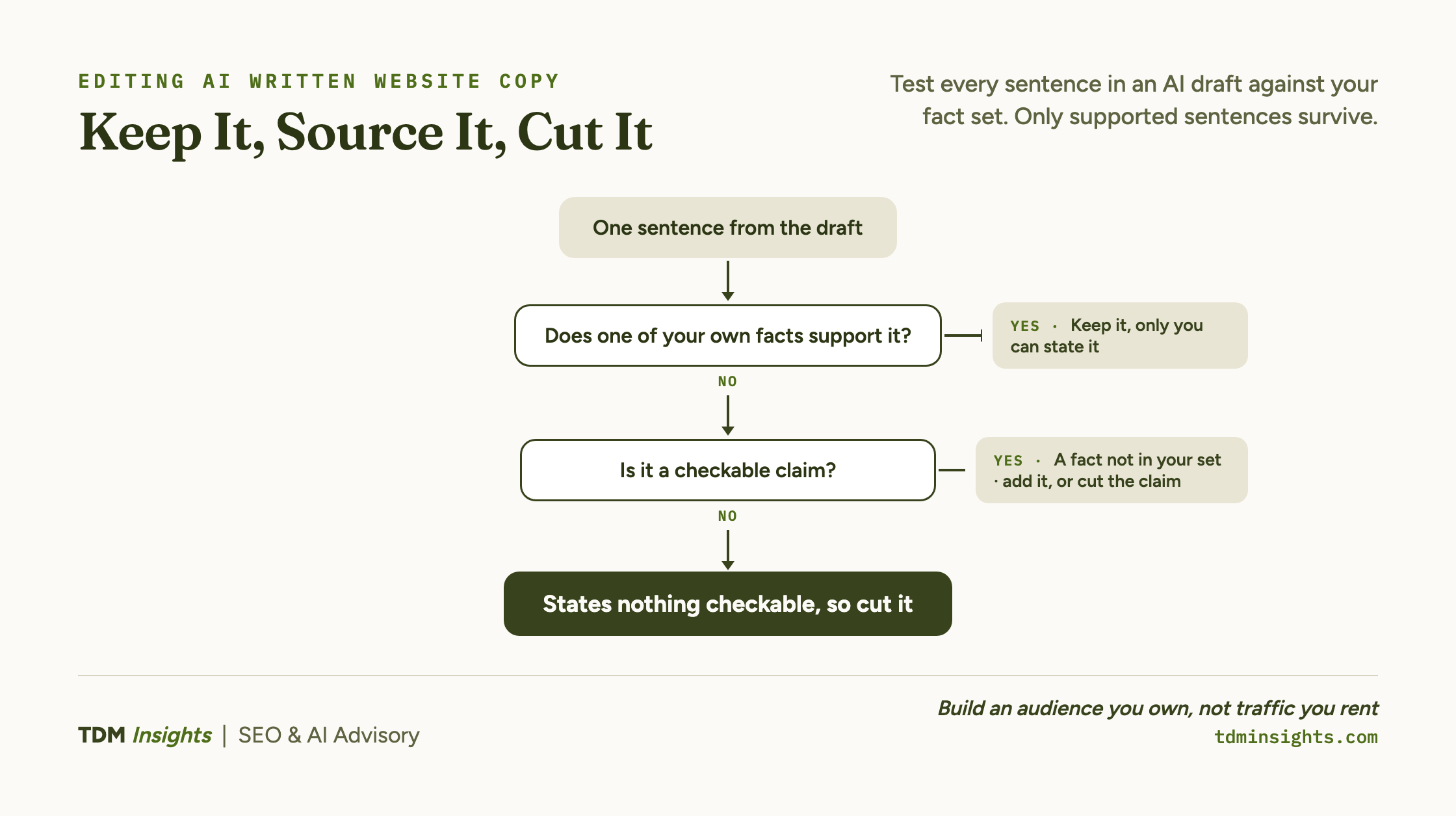
The last step has nothing to do with style. Put the fact set beside the draft and sort every sentence into three buckets.
Bucket one, sentences your fact set supports
These stay, and they are the only sentences a competitor cannot also publish tomorrow. Note which fact each one spends, because a category that never gets spent means a thinner page than it reads.
Bucket two, facts that are not in the set
Each is either a fact you forgot to write down, so add it, or an invention, so cut it. Conductor’s guidance on what AI drafts get wrong states that hallucinations “remain a major risk” and that AI content “should always be fact-checked before publication”. Anthropic’s documentation on citing the documents you supply shows where this heads: each claim returned with the source sentence behind it, which turns the check into a lookup rather than a memory test.
Bucket three, sentences that state nothing checkable
This is the filler, and where generic copy lives. “We pride ourselves on quality” is not false. It is not a claim at all, so there is nothing in it to test, quote, or argue with.
A large bucket three points at the fact set rather than at the draft, and regenerating from the same thin input produces another draft with the same proportions. Search Engine Journal’s reporting on AI content workflows places the same check inside a wider workflow, and it runs after supply. Run it instead of supply and the check turns into a rewrite of sentences that should never have been generated.
Try filling all six categories from memory
Give yourself one sitting. Complete four or more and you have a writing job rather than a gathering job. Stall below four because the answers live with other people, and the job in front of you is gathering instead.
Book a free diagnosis for a second read on which one you face.
Three fact-holders is where a second reader changes the outcome
You can do all of this alone, and for a founder with an empty site that is usually the whole job. Two conditions change it, neither of them about ability.
Condition one, three or more people hold the facts
At one fact-holder this is writing. At three it is interviewing, then reconciling three accounts of the same process that disagree with each other, then deciding which version goes on the page.
That is coordination in a writing job’s clothes, and it scales with the number of people rather than the number of pages, which is why adding pages feels manageable and adding a fact-holder does not.
Condition two, the facts were never written down anywhere
Nobody wrote down the tolerance a technician works to, the reason the intake form asks question four, or the client type the founder quietly stopped taking. Those facts exist only as things people know.
Getting an unwritten fact out of the person holding it is a separate skill from writing the page it lands on, and it is the task founders do worst inside their own business, because a fact is invisible to whoever has held it longest.
A second pair of eyes changes the outcome in both cases, and what it changes is the gathering rather than the prose.
Once the fact set exists, the first page that spends it is the one founders write last. About Page Content and What Actually Belongs on It is where the People and Method facts go to work.
Frequently Asked Questions
Can AI write a website?
It can write the sentences and it cannot supply the facts. A model produces the structure, the headings, and clean prose for every page you need, and none of it will contain your prices, your process, or your constraints unless you hand those over first. Half the job is genuinely covered. The other half stays yours.
Which AI tool is best for writing website copy?
The tool is not the variable that decides your output. Two founders running the same model get different pages because one supplied a written fact set and the other supplied a prompt. Pick whichever tool you find comfortable to work in, then spend the effort you saved on the six fact categories instead.
Why does AI have such a distinct writing style?
Given nothing specific about you, a model returns the statistical average of every business page it has read, and an average reads the same way every time. The recognisable style is a symptom of a supply failure rather than a quirk of the software. Feed it real facts and the sameness drops away.
How do you stop AI copy from sounding like AI?
Fix the input first, then the voice. Editing cadence and hedging does not add a fact the draft never had, so a smoothly rewritten page can still be interchangeable with a competitor’s. Check the draft against your fact set line by line, cut every sentence that states nothing checkable, then do the voice pass on what survives.
Is there an AI tool that can help with copyediting?
Yes, and copyediting is a genuinely good use of one. What it cannot do is tell you the page never named your price, never stated your service area, and never mentioned a single thing you decline. Surface polish and missing substance are separate problems, and only one of them has a tool.
Can you use ChatGPT for copywriting?
Yes, once it has been given something to work from. Paste your offer, boundary, method, proof, people, and failure facts above the instruction, and tell it to mark a gap rather than fill one. Skip that step and you will regenerate the same fluent, interchangeable page indefinitely.
Continue Reading:
Previously in this series
- Website Content Strategy: Money Pages in Four Weeks, the order the money pages ship in, so you know which page each fact is for.
Next in this series
- About Page Content and What Actually Belongs on It, the first page where your People facts and Method facts actually get spent.
From the library
- Writing for E-E-A-T: Prove Experience on the Page, how the Proof facts get shown on a page rather than asserted.
- Content That Converts Readers Into Customers, what the Offer facts have to do once they reach the page, which is close.
- How to Produce Content That Ranks and Gets Cited, turning a collected fact set into a finished page.
Explore TDM Insights Categories